Tuesday, May 25, 2010

"Be killing your sin or your sin will be killing you" — a primer on the power of sin

This Sunday I preached on 1 Samuel 15 and how Saul disobeyed God and refused to put Agag and all the Amalekites do death—as the Lord had commanded. After swiftly progressing through the chapter, we finally arrived at v.33 where it reads: "Samuel hacked Agag to pieces." I think the NIV totally misses it as it says: "Samuel put Agag to death."

וַיְשַׁסֵּ֨ף שְׁמוּאֵ֧ל אֶת־אֲגָ֛ג לִפְנֵ֥י יְהוָ֖ה בַּגִּלְגָּֽל׃

Interestingly, the word is used in modern Hebrew to 'separate' and this was the similar idea long ago as it was a butchering term used to divide and chop up in pieces.

Why such extreme measures? Why did Samuel commit this kind of bloody-gruesome-violent deed? Because it was precisely the man Agag who was the trophy of Saul's disobedience. At the conclusion of the chapter I practically gave three ways that every Christian must strive to put sin to death at its root (this portion of the sermon comprised half of my time).

If you only pluck the weeds in your backyard when they become visible and neglect to pull them up from the root it will sprout up again next week, and the next, and the next. But if you pull it up from the root it will ensure that that weed won't pop up again. So it is with your sin.

It's like Caleb in the movie FIREPROOF. Remember how he was accused by his wife of being "addicted to pornography?" Finally, after repenting and believing in Jesus Christ as Savior and Lord he went home and yanked the computer off the desk, rushed outside, took a baseball bat and hacked that thing to pieces because that computer was the source of his stumbling into pornography. (Obviously there are heart issues to deal with as well—cf. Matt 5:27ff). This is a good example of, as Jesus said, "tear out your eye and throw it from you ... cut off your hand and throw it from you." Do you do this with your sins—specifically? Deliberately? Ferociously?

Here were my three ways to kill sin from its root in your life...

a. Find the root of the sin (32)—Apprehend the cause
b. Hack your sin to pieces (33)—Amputate the sin
c. Walk the path of the godly (34-35)—Alter your life

Note how Jonathan Edwards viewed this:
Resolution #24 — Resolved, whenever I do any conspicuously evil action, to trace it back, till I come to the original cause; and then both carefully endeavor to do so no more, and to fight and pray with all my might against the original of it.
John Owen saw it similarly:
“Watch against the first motions of sin, watch against its beginnings, don’t give it any ground whatsoever. The spiritual disciplines of Bible reading and meditation and prayer are crucial because without them there can be no watchfulness against sin, there can be no sensitivity to its deceitfulness, there will be no protection of the mind. The great wisdom and security of the soul in dealing with indwelling sin is to put a violent stop unto its beginnings, its first motions and actings. Venture all on the first attempt."
So I say: "be killing your sin or your sin will be killing you."

Saturday, May 22, 2010

Humble Christians Repent of Their Sin Rather Than Shifting the Blame to Others...

Matthew Henry wisely remarks (referring to Saul's blame-shifting in 1 Sam 15:15, 21):
"Those that are willing to justify themselves are commonly very forward to condemn others, and to lay the blame upon any rather than take it to themselves. Sin is a brat that nobody cares to have laid at his doors. It is the sorry subterfuge of an impenitent heart, that will not confess its guilt, to lay the blame on those that are tempters, or partners, or only followers in it."

Friday, May 21, 2010

if you're not gripped by God's Word when you preach then bank on it—no one else will be gripped by it either.

Gordon Fee writes:
"Remember: Sermon preparation without personal encounter with the Word and without prayer will probably lack inspiration; and sermons preached by those who have not themselves sat in awful silence before the majesty of God and His Word will probably accomplish very little" (Gordon Fee, New Testament Exegesis, 3rd ed., p.152).

having proper English grammar IS important when you preach.

Those who knew me in high school affirm that I should not be the guy to give English grammar advice, but here it goes. I often hear preachers use grammar incorrectly when they speak of applying texts to you and I (it should be "you and me").

Consider some of the following phrases. Should it be...
1. Pastor Bob and me decided to start a new series... or Pastor Bob and I decide to start a new series...
2. Jerry applied the text to my wife and I or Jerry applied the text to my wife and me.

Here is a very good and clear description of when to use me and when to use I in your preaching.
Just between you and me, today I'm going to talk about the pronouns I and me. I've been meaning to talk about the phrase between you and I for a while, but when I heard that Hillary Clinton had chosen the song “You and I” by Celine Dion for her campaign theme song, I knew it was finally the right time to tackle this topic!

That's because Celine Dion's song “You and I” is grammatically correct, whereas the Jessica Simpson song “Between You and I” is incorrect.

First the basics: the words you, I, and me are all pronouns. They stand in for nouns like Hillary, Jessica, and Grammar Girl.

Pronouns can be subjects, objects, or possessive. I've talked about this before—the subject of a sentence is the agent taking action, and the object is the thing or person being acted upon. If I say, “I love you,” I am the subject (the one doing the loving), and you are the object (the target of my love and the object of my affection).

A possessive pronoun shows that the thing or person possesses something. I won't talk about possessive pronouns anymore today, because they aren't relevant to the topic.

This next part you just kind of have to know. If you've been speaking English for a long time, you probably know it whether you think you do or not, and if you are learning English you just have to memorize it.

I is a subject pronoun, and me is an object pronoun.

The proper sentence is I love you, not Me love you. You use I because the pronoun is the subject of the sentence, and I is the subjective pronoun. And if you've been speaking English your whole life, your ear quickly picks up the difference between right and wrong. I play the marimbas versus Me play the marimbas.

Squiggly loves me is the proper sentence, not Squiggly loves I. I'm the target of Squiggly's love, so I'm in the object position in that sentence, and the objective pronoun is me. Again, in most cases your ear should pick up the difference. He gave the marimbas to me versus He gave the marimbas to I.

The reason it gets a little tricky when you combine I and me with you is that you is both a subjective and an objective pronoun. It's one of those confusing things that just isn't fair. Whether it is in the subject or the object position, you still use the word you. You love Squiggly and Squiggly loves you. They are both correct.

Here's why the song title “You and I” is correct: The title comes from the line You and I were meant to fly. In that line, you and I are both in the subject case. We're taking action—flying.

That seems pretty straightforward. So now we can move on to “Between You and I” and figure out why it's wrong.

Between is a preposition, just as on, above, over, and of are prepositions. Because prepositions usually either describe a relationship, or show possession, they don’t act alone; they often answer questions like Where? and When? For example, if I said, “Keep that secret between you and me,” between describes where the secret is to be kept. If I said, “I'll tell you the secret on July 5,” on describes when the secret will be revealed.

So, instead of acting alone, prepositions are part of prepositional phrases. In those example sentences, between you and me and on July 5 are prepositional phrases. And it's just a rule that pronouns following prepositions in those phrases are always in the objective case (1). When you're using the objective case, the correct pronoun is me, so the correct prepositional phrase is between you and me.

Most grammarians are sympathetic to people who say between you and I because it's considered a hypercorrection. The theory is that people have been so traumatized by being corrected when they say things such as Ashley and me went to the mall instead of Ashley and I went to the mall that they incorrectly correct between you and me to between you and I (2, 3, 4).
Grammar girl.

Thursday, May 20, 2010

P-R-A-Y ... How do you respond when people talk 'behind your back'?

As you know I'm preaching through the book of Psalms and last night I taught on Psalm 64. The psalm marvelously reveals David's (prayerful) response to his enemies who secretly plot verbal attacks against him. David proffers a fitting model for us to glean from when the time comes and we're viciously attacked—verbally, slanderously, maliciously.

I divided the psalm with a four-fold structure and I incorporated in my outline an acronym for P-R-A-Y.

I. P—Petition God's Ear (1-2)


In this section David cries to God with three staccato-like, concise, terse shouts to God:
1. Hear me (1a)
2. Preserve me (1b)
3. Hide me (2)
Amazingly, this section is not just asking God to actually 'hear' his prayer. David knows God will actually 'listen' to his prayer. What David is praying for is for God to act and not be inactive. He wants God to get up and respond to his request! What a good model for us to pray this way. There are times in our lives when we are slandered when we just need to come to God and be honest, open and, can I say "emotional", before God.

II. R—Recognize Your Situation (3-6)

In these verses David relays his situation to God. Oh yes God knows the situation. God knows it better than David himself knows it. Yet it glorifies God when David presents it all at His feet. And, it relieves David to remind himself that he's giving it all up to God. Be specific. Note how David speaks of the malicious, slanderous, cunning, plotting, secretive, vicious, and devious intentions of the wicked men. Bring it to God in prayer! Tell God what's going on in your life. Be specific! Be bold! Be frank! Be open and outright honest with God! He knows your heart and your life and your situations anyway!

Indeed, David concludes in v.6b, the inward thought and the heart of man are deep (cf. Jer 17:9; cp. Prov 22:14; 23:27). There is no 'fear of God' before them (v.4b). A 'lack of fear' is the ultimate characteristic of the wicked. Ironically, those who should fear God the most are those who do not fear God at all. Don't let this be you.

III. A—Affirm Your Trust (7-9)

Here David wonderfully recounts his unswerving and unwavering confidence in God's intercession on his behalf. Note how the enemies want to shoot their arrows (v.4) yet here in v.7a it reads: "but God will shoot at them with an arrow." I love how God only has one arrow; and he only needs one arrow for He never misses the bulls-eye of the wicked man's heart. God, here, intercedes and will judge David's enemies. So, David's response is a confident trust in God. This is how we should respond when we are slandered. Don't take revenge. Don't retaliate. Don't be vengeful. Rather, trust God and know He will (perfectly, wisely, and righteously) judge your (and His!) enemies.

IV. Y—Yield Your Worship (10)

The final verse of the psalm reveals David's commitment to worship God. After all, if David trusts God to destroy and judge the wicked, and if David doesn't need to take matters into his own hands (he could, he's the king!), then he knows he should yield his heartfelt worship to God! He does this in three specific ways:
1. Be glad (=rejoice!)
2. Take refuge
3. Be Praising (NASB: "glory"—the Hebrew word is praise [Hallel, הלל)

So then, when you're slandered, learn from this P-R-A-Y acronym and don't retaliate but give it up to God (all of it!), trust in God, and worship God. It's a good reminder and one that you will need to bear in mind in the near future when slanderous accusers talk behind your back. Get ready. How will you respond?

Wednesday, May 19, 2010

know the gospel. preach the gospel. live the gospel.

From Charles Spurgeon:
"The hearing of the gospel involves the hearer in responsibility. It is a great privilege to hear the gospel. You may smile and think there is nothing very great in it. The damned in hell know. Oh, what would they give if they could hear the gospel now? If they could come back and entertain but the shadow of a hope that they might escape from the wrath to come? The saved in heaven estimate this privilege at a high rate, for, having obtained salvation through the preaching of this gospel, they can never cease to bless their God for calling them by his word of truth. O that you knew it! On your dying beds the listening to a gospel sermon will seem another thing than it seems now."
Heed these wise words!

does God hear the prayers of nonChristians?

No. Scripture is replete with texts clearly stating that the only way to God the Father is through Jesus Christ. Period. No other way is acceptable. Not only does this include salvation but it also includes coming before the Father in prayer.

Last night I preached on evangelism and how it is imperative for the Christian to have a burden for the lost and share the gospel with unbelieving friends, family, and strangers. Afterward, one individual approached me and asked if God hears the prayers of good moral people who are not Christians. I responded by saying: "no."

John 14:6 6 Jesus said to him, "I am the way, and the truth, and the life; no one comes to the Father but through Me.

1 Timothy 2:5 5 For there is one God, and one mediator also between God and men, the man Christ Jesus,

Ephesians 3:11-12 in Christ Jesus our Lord, 12 in whom we have boldness and confident access through faith in Him.

These verses state that it is only through Jesus that anyone can approach God the Father in prayer. It is only those who are redeemed and forgiven and washed who have access in confidence before the Father in prayer (cf. Eph 3:12). You may ask, "well, how does someone get saved, then, if God only hears the prayers of believers?" Good question. At the moment of conversion, when the Holy Spirit miraculously, instantaneously, and supernaturally regenerates the deadened heart and instills salvation in that lost soul, God hears that sinner's cry of repentance and reconciliation and He eagerly forgives and instantly lavishes every spiritual gift on that person (cf. Eph 1:3). But that's at the moment of conversion. Before that, God is deaf to the prayers of nonChristians—indeed, every religion that rejects Jesus Christ as the only way of salvation is false and their prayers are impotent. Moral people nowadays who pray and ask God to help them through their specific 'financial crisis' fall upon deaf ears of God. Why? Because they have no one to plead them before the Father. Their access before the sovereign throne of God Almighty is forbidden.

The solution? Repent, confess, and believe in Jesus Christ! At the moment of saving faith, all access is granted to the sinner to have boldness in speech and access in confidence before God from that moment on—continuing into eternity!

So then, heed the words of Auctor:

Hebrews 4:15-16 15 For we do not have a high priest who cannot sympathize with our weaknesses, but One who has been tempted in all things as we are, yet without sin. 16 Therefore let us draw near with confidence to the throne of grace, so that we may receive mercy and find grace to help in time of need.

Saturday, May 15, 2010

Paul's growth in humility.

One interesting note revealed in the Pauline letters is that his humility seems to go deeper as he senses his own unworthiness as he continues in Christ's ministry. I've heard it said from many men older and much wiser than myself that the longer a man is in ministry the humbler that man becomes. Often I hear it said that the greatest obstacle to young, energetic, dogmatic preachers is pride—pride! We often here such statements (and rightly so!) as: Strangle all pride. Kill all pride. Cut it off. Gouge it out—at its root!

This is not to (even remotely) suggest that the Apostle Paul was prideful at the outset of his ministry but it is to say that the longer a man is in the ministry preaching and teaching God's Word, and the more a man learns more about the unfathomable riches of Christ Jesus, the deeper and stronger and baser that man's humility will be. Paul exemplifies this in three statements.

1. Paul says he is the least of all the apostles (Ἐγὼ γάρ εἰμι ὁ ἐλάχιστος τῶν ἀποστόλων)—1 Cor 15:9.
2. Paul says he is the least of all the saints (ἐμοὶ τῷ ἐλαχιστοτέρῳ πάντων ἁγίων)—Eph 3:8.
3. Paul says he is the worst of all sinners (Χριστὸς Ἰησοῦς ἦλθεν εἰς τὸν κόσμον ἁμαρτωλοὺς σῶσαι, ὧν πρῶτός εἰμι ἐγώ)—1 Tim 1:15

Let me explain. I believe—along with most conservative evangelical NT introductions—that 1 Corinthians was written on Paul's third missionary journey (54-58AD). If this is the case, then Paul may have written 1 Corinthians near the mid-point of this journey. And, it is in 1 Cor 15:9 that he says: "I am the least of all the apostles." Indeed, Paul humbly acknowledges his unworthiness to be termed an apostle.

After this third missionary journey, Paul was imprisoned (in Rome, I believe) for 2 years (61-62AD). It is from Rome that Paul wrote his "imprisonment epistles" (Ephesians, Colossians, Philippians, and Philemon). It was here that he wrote in Eph 3:8: "I am the least of all the saints." Indeed, not only am I the least of all the apostles but now I recognize I'm the least of all the saints!

Finally, Paul's three missionary journeys and his two-year imprisonment in Rome (often termed his "first Roman imprisonment) he was released from this imprisonment (where he traveled extensively and wrote 1 Timothy and Titus). Thus, near the end of Paul's life, just before writing 2 Timothy in the mid 60's, Paul wrote in 1 Tim 1:15 that he is the "worst of all sinners." Indeed, Paul considers himself the chief or foremost of sinners. What an amazing example of humility. God certainly broke and humbled Paul throughout his journeys, travels, preaching tours, persecutions, and imprisonments.

Indeed, may God humble all of us so that we can obey what He says through the words of Peter:

1 Peter 5:6 Therefore humble yourselves under the mighty hand of God, that He may exalt you at the proper time,

Thursday, May 13, 2010

off we go.

Snatching the wife for a couple of days in the (almost always) perfect weather in San Diego.

Wednesday, May 12, 2010

you find contentment when you are satisfied with the glory of God.

From John Piper:
The deepest longing of the human heart is to know and enjoy the glory of God. We were made for this. "ring my sons from afar and my daughters from the end of the earth ... whom I created for my glory," says the Lord (Isaiah 43:6-7). To see it, to savor it, and to show it—that is why we exist. The untracked, unimaginable stretches of the created universe are a parable about the inexhaustible "riches of his glory" (Romans 9:23) ... The ache of every human heart is an ache for this. ... The point is this: we were made to know and treasure the glory of God above all things; and when we trade that treasure for images, everything is disordered. The sun of God's glory was made to shine at the center of the solar system of our soul. And when it does, all the planets of our life are held in their proper orbit. But when the sun is displaced, everything flies apart. The healing of the soul begins by restoring the glory of God to its flaming, all-attracting place at the center (Piper, Seeing and Savoring Jesus Christ, 14-15).

Tuesday, May 11, 2010

a conviction—a belief that seizes a man.

When man holds opinions, it is a belief. But when the beliefs hold a man, it is a conviction. How many of us really have convictions. I mean, full fledged, biblical convictions? We all hold convictions about certain things—family issues, political viewpoints, religious ideologies, relational issues. The man of God, however, must hold firm convictions that nothing, no one, ever can destroy. The believer in Jesus Christ believes the Word of God to be wholly true, perfectly inspired and eminently relevant. It is when this believer, who believes in God's Word is thus held and seized by the objective truth God's Word that he now has a conviction about God's Word.

Convictions just don't change overnight. When a conviction grabs a hold of a man and won't let him go then nothing can sway this person from the truth. All believers are to have convictions. All regenerate persons are to not only hold the truth of God's Word as reliable and trustworthy but be willing to be held by the truth of God's Word as absolutely authoritative and worthy of life-submission.

Beliefs. We all have them. But what is it that holds you?

The wisdom of God in the salvation of God for the people of God.

Tonight I’m preaching on the radical reconciliation between Jew and Gentile in the body of Christ. Paul interrupts himself after v.1 (which he doesn’t pick up again till v.14 in his prayer) with a lengthy parenthetical remark on his stewardship to make known the mystery of Christ.

If I employ verbal aspect to this passage (Eph 3:1-13) there is only one perfect verbal form which gives heightened prominence (marked emphasis) to arrest the listener/reader’s attention on this most-important point.

The perfect verb form is found in verse 9: καὶ φωτίσαι [πάντας] τίς ἡ οἰκονομία τοῦ μυστηρίου τοῦ ἀποκεκρυμμένου ἀπὸ τῶν αἰώνων ἐν τῷ θεῷ τῷ τὰ πάντα κτίσαντι.

Thus, the perfect participle ἀποκεκρυμμένου brings the idea of this mystery which was once hidden but yet it has existed since the eternal times in God (v.9b). But now this mystery (μυστηρίῳ τοῦ Χριστοῦ, cf. v.4) has been revealed where both Jew and Gentile can worship together in one body on equal ground because of Christ’s atoning death.

Not only do we see the amazing plan of salvation revealed where both Jew and Gentile have equal standing before God in the body of Christ but we also stand mind-boggled at the marvelous wisdom of God who had this plan from the eternal times (ἀπὸ τῶν αἰώνων, v.9). What a great God who is unchanging yet all wise and perfectly sovereign over our salvation. Soli Deo Gloria.

Monday, May 10, 2010

Wednesday, May 5, 2010

has your head knowledge become heart affection?

From a Christian brother...
Even great familiarity with the Bible does not guarantee understanding of it, as I can testify from my experience of theological education at a liberal seminary. My New Testament professor carried a Bible as well thumbed as that of a believing Biblicist, but it had apparently done him little spiritual good. He told us of how he had become involved in New Testament study, not out of any reverence for the inspired Word, but because in college he had been introduced to the higher critical method of Bible study, and he had discovered that the exercise of trying to determine the origin of a saying in the gospels was intellectually stimulating. Trying to sift through what he saw as the different levels of tradition to determine whether a saying was original to Jesus or part of early church tradition or the invention of the gospel writer was an enjoyable mental challenge for him. He said that it gave him the same kind of satisfaction as solving a crossword puzzle or figuring out the ending of a mystery novel. He gleefully described how he had squelched a pious but naïve student who once asked him to begin a class with prayer. He was on his fourth marriage, as I recall. His example illustrates how it is possible to derive mental stimulation from the Bible and nothing else.

Tuesday, May 4, 2010

Illumination of the HS when the believer reads the Scriptures, part II

So here is another excellent quote from Fred Klooster on the illumination of the Holy Spirit and how it is inextricably tied with heart-understanding. Read it, and then read it again to make certain you didn't omit anything:
The internal testimony of the Holy Spirit is a heart-rooted conviction that Scripture is the authoritative Word of God. Similarly, the continuing process of biblical interpretation in the process of sanctification should aim also at heart-understanding. Interpretation of Scripture involves much more than head-knowledge or the gaining of information, historical or other. That is why illumination is a continuing need.
—Klooster, "The Role of the Holy Spirit in the Hermeneutical Process," in Hermeneutics, Inerrancy, and the Bible, ed. by Radmacher and Preus (Zondervan, 1984), 461-62.

Inclusio that is rhetorically important that some English versions omit.

In Psalm 62:7 David writes:

עַל־אֱ֭לֹהִים יִשְׁעִ֣י וּכְבֹודִ֑י צוּר־עֻזִּ֥י מַ֝חְסִ֗י בֵּֽאלֹהִֽים׃

Translation: In God is my salvation and my glory; the Rock of my strength and my Refuge is in God.

The original contains an inclusio that some English translations omit—אֱ֭לֹהִים...אֱ֭לֹהִים (God...God). David declares in this psalm that God is his salvation (deliverance) and his glory (worth, sufficiency). Everything that we have or hope to be is to be found in God and God alone. He is the Rock of our strength and our impregnable fortress. He is strong. He is mighty. He is towering. He is powerful.

And the rhetorical device encompassing this verse together is the repetition of "God" (אֱ֭לֹהִים). Thus, David's recognition of his salvation, glory, and protection is rightly grounded in the all-sufficient nature of God and God alone.

Monday, May 3, 2010

The Holy Spirit's role in the believer's biblical interpretation...

This week for my New Testament course, the topic of study is the Holy Spirit's role in our Bible interpretation. I'll be blogging periodically regarding my thoughts on this important aspect of hermeneutics. But to begin, I appreciate what Bernard Ramm notes as he speaks with reference to 2 Cor 4:3-4:

The Text:
2 Corinthians 4:3-6 3 And even if our gospel is veiled, it is veiled to those who are perishing, 4 in whose case the god of this world has blinded the minds of the unbelieving so that they might not see the light of the gospel of the glory of Christ, who is the image of God. 5 For we do not preach ourselves but Christ Jesus as Lord, and ourselves as your bond-servants for Jesus' sake. 6 For God, who said, "Light shall shine out of darkness," is the One who has shone in our hearts to give the Light of the knowledge of the glory of God in the face of Christ.

Ramm's Comment:
When our minds are blinded by the god of this world, everything we read in the New Testament may be equivocated, e.g., 'we are not sure of the Greek,' 'there is a parallel in the mystery cults to this,' 'this is a piece of Judean tradition,' 'this is but Paul's imagination,' or, 'this is a churchy interpolation.' Then, in the midst of our equivocations, God speaks: Let there be light! Immediately this creaturely equivocation ceases; unbelief burns itself out in a moment; and there before the eyes of our hearts stands Jesus Christ giving the light of the knowledge of the glory of God on his blessed face (v.6).
Amen.

Sunday, May 2, 2010

Saturday, May 1, 2010

God in three Persons, blessed Trinity—Ephesians 2.18

Ephesians 2:18, we read:

Greek Text: ὅτι δι᾽ αὐτοῦ ἔχομεν τὴν προσαγωγὴν οἱ ἀμφότεροι ἐν ἑνὶ πνεύματι πρὸς τὸν πατέρα.
Translation: That through Him [Christ, Χριστοῦ [v.13]) we both have access by one Spirit to the Father.

A wonderful reality from Ephesians 2:18 is that the Trinity is clearly seen as we find that Christ is the means by which we are able to have fellowship and access with God the Father. We both—in context this refers to both Jew and Gentile—have access to God through Christ. In other words, regardless of any kind of background whatsoever, those who are joined together and sealed by the Holy Spirit are joined together in unity in the body of Christ. And finally, by means of Christ and in the sphere of the Holy Spirit all believers have access (τὴν προσαγωγὴν) to the Father. This means that the only way God can be approached is by means of Christ and His sacrificial death on the cross for our sins and the indwelling of the Holy Spirit uniting all true believers together. Of course, the glory of salvation briefly revealed here echoes 1:3-14 where the thrice-holy God—Father, Son, and Holy Spirit—accomplishes salvation for His children. Soli Deo Gloria.

Thursday, April 29, 2010

The single (and only) intent and meaning of the biblical A/author is the ONLY meaning of a biblical text.

I like what Walter Kaiser says. I think I'm wholeheartedly committed to this viewpoint.

He summarizes his view that there is only ONE meaning in Scripture and it is the meaning that the A/author (my way of saying both the human author and the divine Author) intended in some helpful axioms.

1. God’s meaning and revelatory-intention in any passage of Scripture may be accurately and confidently ascertained only by studying the verbal meanings of the divinely delegated and inspired human writers (138)

2. Only one verbal meaning is to be connected with any passage of Scripture unless the writer of the text gives literary and contextual clues that he has several aims in view for this exceptional passage (e.g., the two or three questions asked at the beginning of the Olivet discourse (138).

3. That single, original verbal meaning of the human author may be ascertained by heeding the usual literary conventions of history, culture, grammar, syntax, and accumulated theological context. And if it cannot be ascertained by THESE means then it cannot be ascertained at all (138).

4. This authorial meaning can be understood by all readers who will allow the writer to first say what he wants to say without introducing conservative or liberal prejudices as a preunderstanding (138).

5. The personal impact, significance, application, reception, and value this text has for particular individuals or situations is directly linked to the illuminating ministry of the HOly Spirit. The Spirit takes the single truth-intention of the author and in His convicting, comforting, teaching, and motivating power urges us to apply the principle taught in this text to scores of different situations (138).

And then he wisely concludes:
“Nowhere, then, does Scripture support the view that the Bible has a multi-track concept of meanings. If the human author did NOT receive by revelation the meaning in question, then exegetes and readers have no right to identify their meanings with God. Only by following the careful distinctions set forth in the authorial autonomy view can the Word of God be preserved for future generations and be handled as what it is indeed—the powerful and authoritative Word from God” (141).
Source:
Kaiser, Walter C., Jr. “The Single Intent of Scripture.” In Evangelical Roots: A Tribute to Wilbur Smith. Edited by Kenneth S. Kantzer, 123–41. Nashville: Thomas Nelson, 1978.

Man's 'free-will' and God's utter sovereignty—foes or friends?

I recently received this question from a friend from church:

Question:
I don't understand the relationship between freewill and God's plan. How do the two fit together? Any scripture and comments you have on the subject would be helpful. Thanks.

My Answer:
That is a great question and one that many people struggle with because there are so many issues involved.

First of all, with an issue like this, we must remember first that God is perfectly good and has all (infinite) wisdom and understanding.

Isaiah 55:9 9 "For as the heavens are higher than the earth, So are My ways higher than your ways And My thoughts than your thoughts.

Romans 11:33-34 33 Oh, the depth of the riches both of the wisdom and knowledge of God! How unsearchable are His judgments and unfathomable His ways! 34 For WHO HAS KNOWN THE MIND OF THE LORD, OR WHO BECAME HIS COUNSELOR?

So, we must first understand that whatever God says HE fully and totally understands. We may not fully understand it because we DON'T know everything (but God does!). That's why He's God and we're not!

Second, the Bible declares time and time again that God is sovereign (=that is, God is the King and is in CONTROL of everything—absolutely everything).

Psalm 103:19 19 The LORD has established His throne in the heavens, And His sovereignty rules over all.

Psalm 115:3 3 But our God is in the heavens; He does whatever He pleases.

Isaiah 46:10 10 Declaring the end from the beginning, And from ancient times things which have not been done, Saying, 'My purpose will be established, And I will accomplish all My good pleasure';

See also Psalm 93:1; 97:1; 99:1; 1 Timothy 1:17; Ephesians 1:11 (and many more!)

So, we must believe that God has ORDAINED everything that ever comes about (God is perfectly in control; he never is OUT of control; he never has to go to "plan B". God never makes a mistake. Everything that happens (everything!) is in God's determined will/decree. That's a hard concept to grasp but this is the simple truth. I wouldn't want to worship any other God...would you? I'm glad I worship a God who is control of everything (even earthquakes, natural disasters, tsunamis, death, murder, government...etc.).

Third, we also know from the Bible that God has commanded man to "make choices."

Joshua 24:15 15 But if serving the LORD seems undesirable to you, then choose for yourselves this day whom you will serve,

Deuteronomy 30:19 19 This day I call heaven and earth as witnesses against you that I have set before you life and death, blessings and curses. Now choose life, so that you and your children may live

Acts 16:31 31 They replied, "Believe in the Lord Jesus, and you will be saved-- you and your household."

And many many more...

So, The Bible also declares that even though God is in total and absolute control of everything, man also is called to "believe" or "choose" or "decide"... etc. This seems like an irreconcilable contradiction. But rather this evidence that we must believe in both truths. In the mind of God (the perfect all-knowing God) the two fit together beautifully. But in our human, feeble, finite minds, we're not sure how it all fits together.

So, here's my conclusion: God has ordained everything that ever happens (he's in control). Yet, I still have a responsibility (on the human side) to believe in the LORD, pursue Christlikeness and holiness, believe in the LORD, share my faith with my friends, etc.

Check out this verse that clearly reveals both truths:

Acts 16:14 14 A woman named Lydia, from the city of Thyatira, a seller of purple fabrics, a worshiper of God, was listening; and the Lord opened her heart (God's control and sovereignty) to respond (human responsibility) to the things spoken by Paul.

And again...

Acts 13:48 48 When the Gentiles heard this, they began rejoicing and glorifying the word of the Lord; and as many as had been appointed to eternal life (God's election and sovereignty) believed (human responsibility).

In heaven, we can ask the LORD how it all fits together and he'll explain it all to us! But for now, we have to submit to God's Word (the Bible) and believe what it clearly teaches, namely, God is in perfect control as the all-knowing and all-powerful King and yet we as humans are called to live life with all our might for God's glory and for His pleasure! I love the fact that they are NOT contradictions but they fit together beautifully in the mind of God. So we must submit to God's Word and accept both concepts as true and reliable.

I preached on this very issue at Church a while ago. You can listen to the sermon here.

Wednesday, April 28, 2010

Lead me to the Rock that is higher than I.

Tonight I'm preaching Psalm 61 and the thrust of the psalm is being led by God to Himself who is our refuge and tower of protection.I found a few YouTube videos that may help put the images in perspective. Watch here and here.

I love what Spurgeon says...
How infinitely higher than we are is the salvation of God. We are low and grovelling, but [the protection/salvation of God] towers like some tall cliff far above us. This is its glory, and it is our delight when we have once climbed [onto] the rock and claimed an interest in it; but while we are as yet trembling seekers, the glory and sublimity of salvation appall us, and we feel that we are too unworthy even to be partakers of it; hence we are led to cry for grace upon grace, and to see how dependent we are for everything, not only for the Savior, but for the power to believe on him.

Sunday, April 25, 2010

Will You Be Judged at the Great White Throne Judgment? Everyone Standing at This Judgment Will Be Damned.

Last night I preached one of the hardest sermons a preacher could ever teach. It wasn't hard because there were so many varying interpretations but it's hard because it such an unpopular message nowadays to proclaim. That message is on the Great White Throne judgment. I titled it: "Will your works damn you at the Great White Throne Judgment?"

I believe that this judgment is for non-believers only and that no believers will be at this judgment (Rom 8:1; John 3:18, 36). Nevertheless, this is one of the scariest portions of Scripture because there is no hope for the lost at this time. There is no second chance. The eternal Lake of Fire is the inevitable and sure outcome of this judgment for all who stand before the bar of God and are carefully scrutinized according to their every work to see if they can enter eternal bliss.

I preached this last night at a Rehab center and opened with a 10 minute anecdote on a man who died and was judged and condemned at the Great White Throne judgment. This story arrested everyone's attention. I urge you to listen and do what the Apostle Paul says: "Test Yourself to see if you're in the faith" (2 Cor 13:5).

Listen here.

Friday, April 23, 2010

Thursday, April 22, 2010

Wednesday, April 21, 2010

Tuesday, April 20, 2010

Step back and look at the big picture.

"To study John's gospel in detail for the first time is like becoming heir to an ancient, beautiful tapestry. Its artistry astounds. And the closer we examine it, the more we are awed by mysteries hidden from the casual observer. To understand the part we must stand back and comprehend the whole. And when we investigate its background and history, its value and uniqueness—even its message—acquire an entirely new depth" (Gary M. Burge, "Interpreting the Gospel of John," in Interpreting the New Testament: Essays on Methods and Issues, ed. by Black and Dockery [Broadman & Holman], 383).

Monday, April 19, 2010

preach.

“Let the pastors boldly declare all things by the word of God, of which they are constituted administrators. Let them constrain all the power, glory, and excellence of the world to give place to and to obey the divine majesty of the word. Let then enjoin everyone by it, from the highest to the lowest. Let them edify the body of Christ. Let them devastate Satan’s reign. Let them pasture the sheep, kill the wolves, instruct and exhort the rebellious. Let them bind and loose, thunder and lightening, if necessary, but let them do all according to the word of God.”

—John Calvin

Friday, April 16, 2010

A preacher's reminder. A needed checkup to faithfully exposit God's Truth.

Some good soul food for the day...

The preacher is a herald; his work is heralding the King's message. . . . Now the herald does not invent his message; he merely transmits and explains it. It is not his to criticise its wisdom or fitness; this belongs to his sovereign alone. On the one hand, . . . he is an intelligent medium of communication with the king's enemies; he has brains as well as a tongue; and he is expected so to deliver and explain his master's mind, that the other party shall receive not only the mechanical sounds, but the true meaning of the message. On the other hand, it wholly transcends his office to presume to correct the tenour of the propositions he conveys, by either additions or change. These are the words of God's commission to an ancient preacher: "Arise, go unto Ninevah, that great city, and preach unto it the preaching that I bid thee."

The preacher's task may be correctly explained as that of (instrumentally) forming the image of Christ upon the souls of men. The plastic substance is the human heart. The die which is provided for the workman is the revealed Word; and the impression to be formed is the divine image of knowledge and true holiness. God, who made the soul, and therefore knows it, made the die. He obviously knew best how to shape it, in order to produce the imprint he desired. Now the workman's business is not to criticise, recarve, or erase anything in the die which was committed to him; but simply to press it down faithfully upon the substance to be impressed, observing the conditions of the work assigned him in his instructions. In this view, how plain is it, that preaching should be simply representative of Bible truths, and in Bible proportions! The preacher's business is to take what is given him in the Scriptures, as it is given to him, and to endeavour to imprint it on the souls of men. All else is God's work. The die is just such, so large, so sharp, so hard, and has just such an "image and superscription" on it, as God would have. Thus He judged, in giving it to us. With this, "the man of God is perfect, thoroughly furnished unto all good works." (2 Tim 3:17) This is enough for us.

Source: R.L. Dabney, Evangelical Eloquence: A Course of Lectures on Preaching, 36-3

Thursday, April 15, 2010

Psalm 59 - How to pray when enemies surround your house.

Last night I preached Psalm 59 which records David's prayer to God when Saul sent men to surround David's house to kill him. That historical situation is recounted in 1 Samuel 19:11ff. Amazingly, David's prayer reflects a man who begs God for refuge, asks God to destroy the wicked, and resolves in his own heart to praise God in song.

Psalm 59 is quite amazing in the structure (which baffles commentators across the board) and in its dealings with the problem of evil (=theodicy).

In this prayer, David transitions from:
1. Deliver me, O God!
2. Destroy them, O God!
3. Delight in my praises, O God!

Feel free to listen here.

Wednesday, April 14, 2010

Monday, April 12, 2010

Preach the gospel as if it all depends on you; yet know God is the One who changes the sinner's heart.

Because it is my responsibility to share the gospel as if souls could die before the sun goes down I must evangelize with urgency. Meanwhile, because it is God’s sovereignty that opens the sinner’s heart to hear the word, accept the word, understand the word, and believe the Word, I evangelize with confident trust that God’s sovereign purposes shall be accomplished.

Last night I had the wonderful privilege of meeting and sharing the gospel with a man at a BBQ. It was quite a lengthy conversation and this fellow knew Scripture—or, I should clarify and say that he knew some ‘random’ Bible verses yanked out of context to suit his own purposes. At any rate, he told me that all roads lead to the same ultimate destination. He told me that God speaks to him and that he also believes in reincarnation. Fundamentally, he finally agreed with the statement I posed to him that all relations essentially teach the same thing: man must work hard and do good to attain the best that the divine has to offer in the next life. He agreed.

Then I shattered the thinking with telling him that is not what the Bible teaches—at all! The faith of the Bible is of an entirely different form than any and every other religion. It is not about man doing good and ‘earning’ the ultimate utopia; rather, it is about God—the perfectly holy, the impeccably righteous, and the unspeakably just God—coming to man and saving his sinful, wretched soul.

Amazingly, there were others who were sitting and listening to the conversation. It was a wonderful opportunity to proclaim the gospel of Jesus Christ—and that salvation is only in Jesus Christ—not only to this fellow but also to others who were sitting at the table listening intently.

Every opportunity that God afforded me, I brought the issue back to the fundamental truths: (1) Everyone needs an objective standard (=the Bible); your thoughts, my opinions, another’s ideas will not do. That’s subjectivism and that leads only to debate and ideas. But God’s objective truth is unchanging and true. (2) Jesus Christ clearly taught that He was the only way to God the Father. Everyone who tries to get in the sheepfold any other way is a thief, a robber, and is destined for hell (John 14:6; cf. 1 Tim 2:4-5; Acts 16:31; Rom 10:13ff). (3) Everyone must come to grips with and answer this plaguing question: “How can I—an imperfect, unholy sinner—enter into eternal bliss with Almighty God who is perfectly Holy and CANNOT look upon my wickedness with favor?”

The night had to end because we had to drive home and put our son to bed. But I pray that God’s Word will work effectually in this man’s heart and soul. I pray that the other ladies at the table will take heart to what they heard from the truth of God’s Word.

I love evangelism. I love preaching the gospel. I love knowing that it’s my job to preach as if souls were going to die before the day ends and stand before a holy God with one of two destinies awaiting them. But I find greater comfort in the sovereignty of God who is the only One able to work in and change the dead human heart.

Isaiah 55:10-11 10 "For as the rain and the snow come down from heaven, And do not return there without watering the earth And making it bear and sprout, And furnishing seed to the sower and bread to the eater; 11 So will My word be which goes forth from My mouth; It will not return to Me empty, Without accomplishing what I desire, And without succeeding in the matter for which I sent it.

Saturday, April 10, 2010

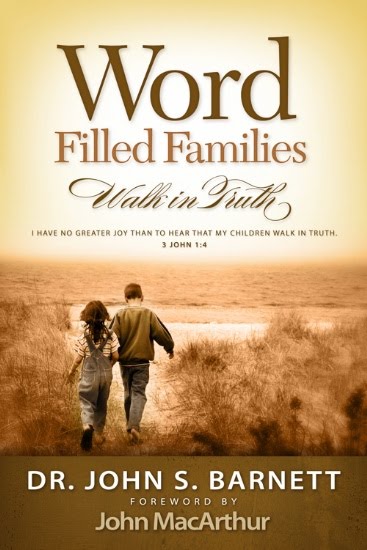
Barnett - Word Filled Family Book Review

Just posted a book review on our church website of John Barnett's book, Word-Filled Families: Walk in Truth. It is an excellent book that definitely deserves a close examination by every husband, wife, and parent.

Read my full pdf review here.

Here's my conclusion:

In conclusion, I wholeheartedly commend this book to everyone who is married, considering marriage, engaged, with or without children (whether they haven’t been born yet (!), whether they are young children, teenagers, or out of the home) as this book will be a great encouragement and tool to convict you of sin and give the practical solutions to implement the recommended truths to your Christian life so that you can have a word filled family and, most of all, glorify the God who made you and created you to make much of him and model His relationship with you in your marriage (and, by extension, family).

Friday, April 9, 2010

Parenting checkup...

Here are four helpful principles to remember:

1. Discipline must be firm, fair, and consistent.
2. A parent must know where his or her children are and what they're doing at all times, and be with them as much as possible.
3. Children need to see love demonstrated between the father and mother, and see genuine love lived out before them.
4. A family must be cohesive, regularly spending time together.

John Barnett, Word Filled Families, 179.

Thursday, April 8, 2010

Psalm 58:10 - Rejoice at the Destruction of the Wicked?

Does the Bible really say that the righteous will rejoice at God's vengeance upon the wicked? Yes, it does.

First of all, the Bible no where advocates or condones people rejoicing over the downfall of the enemy because of personal vengeance. All vengeance must be left to the LORD (Deut 32 and Rom 12). Nevertheless, when the Christian has a God-centered perspective, it is absolutely reasonable—yes, required—that believers rejoice at the destruction of the wicked. (Again, this is not personal vengeance or gloating that the wicked are finally cast into hell.)

But in my sermon last night I provided seven reasons why the righteous will rejoice at the judgment of the wicked:

1. God commands it (Rev 19:1-10)

In a mysterious way, God commands believers to rejoice because His judgments are poured out upon the wicked. Just read Revelation 19:1 (which immediately follows Rev 17-18 and the cataclysmic destruction of Babylon, the false religious system and the false political system during the Tribulation; that is to say, it is no 'lightweight' judgment) when the believers "rejoice" and "sing" and "make music" when God's judgments are poured out.

2. God’s righteous and holy character is vindicated

This requires a God-centered perspective. We think often of the love and mercy of God—and rightly so. But when we mention the holiness and justice and wrath of God we recognize that God is the Judge who has every single individual before Him absolutely and undeniably guilty of eternal charges! For God to judge them eternally and violently is absolutely in tune with His holy character. Thus, believers must rejoice because GOD is being vindicated.

3. The unrighteous rebellion is finally judged

When God judges the wicked, the righteous should rejoice because all unrighteous rebellion will be judged. When God finally judges the lawless, their rebelliousness will be condemned with them and thus will eradicate rebellion on earth (cf. Rev 20:11-15 for this final judgment). That is one reason why believers should rejoice!

4. God’s power is displayed in showing his supremacy

God displays his absolute and unsurpassed power in destroying the wicked. Only God can do such a widespread and universal act. Thus, when God destroys the wicked and brings vengeance upon them, the righteous must rejoice because God's power and God's supremacy is beautifully and gloriously put on display.

5. God’s faithfulness and truthfulness is proven as he does what he has promised all along—judge the wicked; thus we rejoice.

God has promised since the beginning (Gen 3) that He would judge sin. No one can deny that. Thus, God has made promises all throughout Scripture (hundreds and hundreds of them) that He will destroy the unrighteous and deliver the righteous. When God does, in the end, destroy the wicked and bring His vengeance upon them, God is just showing that "He is faithful" and that "He fulfills His promises." This is simply to say, "God keeps His Word!"

6. God’s sovereignty is displayed showing no one has absolute dominion like He does.

No one has dominion and sovereignty like God. No one. For God to judge sin and sinners is part of his character. It reveals His absolute kingship. We must rejoice because God's sovereignty is revealed when He (and only He can do this!) brings His vengeance upon those who reject Him and rebel against Him.

7. The destruction of the wicked means eternal glorification in perfection for the saints.

Finally, believers must rejoice because the eternal destruction of the wicked means eternal glorification for the saints. When God finally and fully punishes all sinners, then the eternal state of glory will have come. Eternal judgment for the wicked guarantees eternal life for the righteous.

Note that none of these seven points includes the righteous rejoicing that the wicked are finally pounded with God's judgment (=this is vengeance and we must leave that to God). Rather, with a God-centered perspective—that is to say, that God does absolutely everything to magnify His Name and exalt His own Character—all of these points are not only reasonable, they are desirable and anticipated. God is a good God who must punish sin.

For the believer in Jesus Christ:
Romans 5:9-10 Much more then, having now been justified by His blood, we shall be saved from the wrath of God through Him. 10 For if while we were enemies we were reconciled to God through the death of His Son, much more, having been reconciled, we shall be saved by His life.
For the Nonbeliever in Jesus Christ:
Deuteronomy 32:35-42 35 'Vengeance is Mine, and retribution, In due time their foot will slip; For the day of their calamity is near, And the impending things are hastening upon them.' 36 "For the LORD will vindicate His people, And will have compassion on His servants, When He sees that their strength is gone, And there is none remaining, bond or free. 37 "And He will say, 'Where are their gods, The rock in which they sought refuge? 38 'Who ate the fat of their sacrifices, And drank the wine of their drink offering? Let them rise up and help you, Let them be your hiding place! 39 'See now that I, I am He, And there is no god besides Me; It is I who put to death and give life. I have wounded and it is I who heal, And there is no one who can deliver from My hand. 40 'Indeed, I lift up My hand to heaven, And say, as I live forever, 41 If I sharpen My flashing sword, And My hand takes hold on justice, I will render vengeance on My adversaries, And I will repay those who hate Me. 42 'I will make My arrows drunk with blood, And My sword will devour flesh, With the blood of the slain and the captives, From the long-haired leaders of the enemy.'

Wednesday, April 7, 2010

Monday, April 5, 2010

Friday, April 2, 2010

The resurrection of Jesus Christ affects every theological category.

The literal, physical, bodily resurrection of Jesus Christ is incredibly important. It affects all doctrines…
  • Bibliology (=Bible) – Jesus’ resurrection is announced and proclaimed as undeniable historical fact in the true, inerrant, and inspired pages of Scripture. You deny the resurrection, you deny God’s Word as true and therefore make God a liar.
  • Theology Proper (=God) – Jesus’ resurrection reveals the absolutely unstoppable and unsurpassing power of God who can raise the dead to new life!
  • Anthropology – Jesus had to die and conquer death because man is so sinful and helpless that he can’t conquer death in his own strength
  • Christology – Jesus’ resurrection shows that He Himself has the power to rise from the dead—proof of his deity!
  • Pneumatology – Jesus rose from the power of the Holy Spirit who is God and able to raise Christ from the dead.
  • Angelology – The angels at the tomb were faithfully announcing that Jesus was not there—He had RISEN, just as he said!
  • Soteriology (=salvation) – The resurrection of Jesus guarantees that we as sinners have a living Savior who has conquered the grave and has secured our salvation.
  • Israelology – The resurrection of Jesus shows how Jesus fulfilled Isaiah’s prophecy to Judah about their coming Messiah who would “prolong his days” and “See his offspring again” (Isaiah 53:10) and it guarantees that Jesus will give spiritual life and raise the deadened Israelites to new spiritual life in the future (Romans 11:25-27).
  • Ecclesiology – Just as Jesus’ resurrection shows his life that he will live forevermore, so it is with the Christian who is spiritually resurrected. He now and forevermore is a part of the Church—the Body of Christ!
  • Eschatology – Jesus’ resurrection absolutely guarantees that He will come back someday and raise US and all who have died “in Christ” to be with Him in the glories of heaven to dwell with Him in eternal bliss and happiness!
Praise God that Jesus is ris'n from the dead!

Romans 4:25 25 He who was delivered over because of our transgressions, and was raised because of our justification.

Thursday, April 1, 2010

Shall we dialogue on Sunday morning? Do you preach via monologue or dialogue?

These last few weeks have submerged me in the wonderful realm of preaching the Bible. More specifically, though, I've been grappling with the idea of expository preaching and if there is an occasion where "dialogue"—verbal, interactive dialogue—is acceptable during the Sunday morning church service (note my qualification of the Sunday morning service only; I deliberately have excluded such studies as the Sunday evening service, mid-week service, a home community group, etc.). In my thinking, reading, and consideration of God's Word, I am convinced that preaching via monologue is the best way to communicate on a Sunday morning.

One of the quotes I came across was from Jack Hughes. Enjoy!
Many pastors are struggling to keep their churches from becoming like the church of Sardis. They try biblical exposition, but something doesn’t seem to be working right. They faithfully preach the word, but contrary to the promise of God in Isaiah 55:11, the word of God seems to come back void. Their church doesn’t grow spiritually or numerically. People don’t seem to be responding. As they struggle to maintain a good attitude and fight the good fight, they see the church that doesn’t do expository preaching growing by leaps and bounds. Legions of cars pack the car park of the ‘seek sensitive church’ Saturday night, Sunday morning, and Wednesday night because it is meeting ‘felt needs’. . . . It can make an expositor have second thoughts. ‘Maybe biblical exposition is a cultural thing. Times have changed. Maybe expository preaching is out, and we should try something new.’ Snap out of it! Don’t even begin to entertain such thoughts. Satan is willing to trade solid biblical preaching for numerical growth. He would be glad to fill your car park if you will dump expository preaching. Satan skips with joy when expository preaching is substituted with anything else. He knows, if he can get rid of expository preaching, he can steer the church any way he wants. Satan knows that, when faithful preaching is set aside, the church will become vulnerable to his subtle deceptions and become ineffective.
From: Jack Hughes, Expository Preaching with Word Pictures, 8–9.